
In the case of
David John Cawdell Irving, Plaintiff
against
(1) Penguin Books Limited, First Defendant
(2) Deborah E. Lipstadt, Second Defendant
Germar Rudolf, January-April 2000
"The Leuchter report 13.79 The reason why Irving initially denied the existence of gas chambers at Auschwitz was, as has been seen, the Leuchter report. I have summarised in some detail the findings made by Leuchter at paragraphs 7.82 to 7.89 above. I will not repeat myself. I have also set out at paragraphs 7.104 to 7.108 above the reasons why van Pelt on behalf of the Defendants dismissed the Leuchter report as flawed and unreliable. Those reasons were put to Irving in cross-examination. It is a fair summary of his evidence to say that he accepted the validity of most of them. He agreed that the Leuchter report was fundamentally flawed. In regard to the chemical analysis, Irving was unable to controvert the evidence of Dr Roth (summarised at paragraph 7.106 above) that, because the cyanide would have penetrated the brickwork and plaster to a depth of no more than one tenth of the breadth of a human hair, any cyanide present in the relatively large samples taken by Leuchter (which had to be pulverised before analysis) would have been so diluted that the results on which Leuchter relied had effectively no validity. What is more significant is that Leuchter assumed, wrongly as Irving agreed, that a greater concentration of cyanide would have been required to kill humans than was required to fumigate clothing. In fact the concentration required to kill humans is 22 times less than is required for fumigation purposes. As indicated in paragraph 7.105 above, and as Irving was constrained to accept, Leuchter's false assumption vitiated his conclusion. Irving conceded the existence of many other factual errors in the Leuchter report. 13.80 In the light of the evidence of van Pelt and Irving's answers in cross-examination, I do not consider that an objective historian would have regarded the Leuchter report as a sufficient reason for dismissing, or even doubting, the convergence of evidence on which the Defendants rely for the presence of homicidal gas chambers at Auschwitz. I have not overlooked the fact that Irving claimed that Leuchter's findings have been replicated, notably in a report by Germar Rudolf. But that report was not produced at the trial so it is impossible for me to assess its evidential value."
Judgment of Justice Gray, Queen’s Bench Division, Royal Courts of Justice, Strand, London, David John Cawdell Irving ./. (1) Penguin Books Limited, (2) Deborah E. Lipstadt, Ref. 1996 I. No. 113, April 11, 2000, Section 13.79f.
"First of all virtually nothing is left of these structures except concrete slabs and some low walls reconstructed after the war, and the blueprints of these buildings do not show any designation of gas chambers as morgues. So it is unclear on the basis of what evidence he [Leuchter] was able to come to a verification in the case of crematoria 4 and 5."This statement shows the preoccupation of van Pelt: He is right that nothing on the blue prints designates the rooms he refers to as "morgues", but there is nothing that designates them as 'gas chambers' either! In fact, we do have a clue from the blueprints of these rooms that indicates what they were planned for originally. The spots where the lights were to be built in are marked as "ex.gesch." which means "explosionsgeschütz" (explosion proof).[11] That indicates the intention of the planning architects to fill these rooms with explosive gases like hydrogen cyanide ("Zyklon B") in a concentration,[12] which could at least come close to an explosive level. If Prof. van Pelt were right that homicidal mass gassings with Zyklon B do not require any protection against explosion [pp. 289f., 332, 340], then these provisions indicate that the rooms were indeed intended to serve as delousing chambers, and not as 'homicidal gas chambers', as he claims. On the other hand, if homicidal mass gassings would have borne the risk of an explosion, then the fact that such provisions were not included in the basement rooms of the crematoria II and III in Birkenau labelled by van Pelt as 'gas chambers' is an indication that they were not intended to be used as such (the blueprints say they were simple "morgues"!). In any case, van Pelt's way of arguing brings him in contradiction with the facts.
The sides of these pillars, which went up through the roof, were of heavy wire mesh. Inside this grid, there was another finer mesh and inside that a third of very fine mesh. Inside this last mesh cage there was a removable can that was pulled out with a wire to recover the [Zyklon] pellets from which the gas had evaporated.For this he mainly relies on two 'witness' accounts:
The roof of the gas chamber was supported by concrete pillars running down the middle of its length. On either side of these pillars there were four others, two on each side. The sides of these pillars, which went up through the roof, were of heavy wire mesh. Inside this grid, there was another finer mesh and inside that a third of very fine mesh. Inside this last mesh cage there was a removable can that was pulled out with a wire to recover the pellets from which the gas had evaporated.Van Pelt describes Tauber as follows [p. 112]:
Tauber's testimony is, without doubt, the most important record of the extermination procedure taken immediately after the war. It is largely corroborated by the contemporary testimonies of Jankowski and Dragon, and by the later memoirs of Filip Müller.And in his footnote 87 van Pelt adds [p. 138]:
It is highly unlikely that Filip Müller's memoirs was inspired and or shaped by Tauber's testimony.Maybe he is right with that, but has he noted that Müller copied entire sentences form the testimony of Miklos Nyiszli?[14] So Müller's forgery certainly cannot corroborate anything. Henryk Tauber is nevertheless an important witness, as his good knowledge about many details of the crematoria indicates that he indeed was working inside them. However, some of his statements are obviously absurd and/or impossible, indicating that Tauber tended to exaggerate and invent certain stories [van Pelt p. 108, 15]:
During the incineration of such [not emaciated] corpses, we used the coke only to light the fire of the furnace initially, for fatty corpses burned of their own accord thanks to the combustion of the body fat. On occasion, when coke was in short supply, we would put some straw and wood in the ash bins under the muffles, and once the fat of the corpse began to burn the other corpses would catch light themselves. […] Generally speaking, we burned 4 or 5 corpses at a time in one muffle, but sometimes we charged a greater number of corpses. It was possible to charge up to 8 “Müselmanns.” Such big charges were incinerated without the knowledge of the head of the crematorium during air raid warnings in order to attract the attention of airmen by having a bigger fire emerging from the chimney.In their vast thermodynamic study, Franco Deana and Carlo Mattogno have shown that it is impossible that corpses burn totally "of their own accord", that you could light corpses with a simple straw and wood fire, that a fat corpse can light and incinerate meager ones. Apart from that, the procedure described by Tauber is absurd: Lighting a fire "in the ash bins under[sic!] the muffles" to burn a corps on top of these ash bins is impossible. These "ash bins under the muffles" were meant to gather the ashes of the incinerated corpses. The gas flow of such a cremation is as follows: fresh air from oven room ® coke gas generator (fire) ® muffle with corpse ® ash bin ® recuperator ® flue ® chimney Provided, this air flow would be maintained, any fire lit in the ash bin would just heat up recuperator, flue, and chimney, but couldn't "light' any corpses on top of it. It is more likely, however, that a fire lit in the ash bin would turn around the flow direction of the gases, as hopt gases tend to flow upward: chimney ® flue ® recuperator ® ash bin ® muffle with corpse ® gas generator ® oven room That means that the hot exhaust gasses would pour into the oven room, which would have been quite disastrous. Furthermore, Deana and Mattogno have shown that even if it were possible to fit two or even three corpses at one time in a muffle (one cannot get more than three in there due to the limited height of the doors), it wouldn't make any sense as the incineration process is drastically slowed down due to several thermodynamic effects (reduced surface/volume ratio, narrowed and thus accelerated hot air flowthrough leading to increased energy loss).[16] Tauber's assertion that the Sonderkommando put up to 8 corpses into a muffle is therefore a lie. Deana and Mattogno proved additionally that it is impossible to get flames coming out of any crematorium chimney, as they had to travel some 30 m through flue and chimney to reach the open. No flame can be that long, except in case of an explosion, which would have damaged or destroyed the crematorium. A few lines later, Tauber writes (italic numbers in brackets refer to pages in J.-C. Pressac) [van Pelt p. 109]:
Once the people were in the gas chamber, the door was closed and the air was pumped out. [489]That is absurd and technically impossible. Elsewhere Tauber writes [van Pelt p. 109f.]:
Another time, the SS chased a prisoner who was not working fast enough into a pit near the crematorium that was full of boiling human fat. At that time, the corpses were incinerated in open air pits, from which the fat flowed in to a separate reservoir, dug in the ground. This fat was poured over the corpses to accelerate their combustion. This poor devil was pulled out of the fat still alive and then shot. [499]It is true that flesh burned in fire releases fat. But since fat is highly inflammable, one cannot collect it. And fat does not boil, it decomposes and catches fire beyond a certain temperature (184°C/363°F[17]). Tauber is telling atrocity stories which cannot be true. Tauber continues [van Pelt p. 111]:
So, during the incineration of fat bodies, the fires were generally extinguished. When this type of body was charged into a hot furnace, fat immediately began to flow into the ash bin, where it caught fire and started the combustion of the body. [495]I quote this nonsense only in order to show that Tauber knows very well that fat, once released, catches fire when it is being heated beyond a certain temperature… And later: [van Pelt p. 112]
It was realized that the pits burned the corpses better, so the crematoria closed down one after the other after the pits came into operation. [500]Nothing could be more wrong. Would that be true, mankind would have never developed crematories. In fact, by storing and reflecting the heat that would otherwise be lost, the fireproof brick walls of the crematorium muffles are the components which save energy, allow higher temperatures and thus accelerate the incineration process. In an open air cremation, huge amounts of energy are being lost due to radiation an convection. After having had a closer look into van Pelt's (and Pressac's) star witness' testimony, who can honestly believe Tauber's extermination stories?
Among other things the metal workshop made the false showers intended for the gas chambers, as well as the wire-mesh columns for the introduction of the contents of the tins with Zyklon into the gas chambers. These columns were around 3 meters high, and they were 70 centimetres square in plan. Such a column consisted of 6 [recte: 3] wire screens which were built the one within the other. The inner [recte: outer] screen was made from 3 millimeter thick wire, fastened to iron corner posts of 50 by 10 millimeters. Such iron corner posts were on each corner of the column and connected on the top in the same manner. The openings of the wire mesh were 45 millimeters square. The second screen was made in the same manner, and constructed within the column at 150 millimeters distance from the first. The openings of the second were around 25 millimeters square. In the corners these screens were connected to each other by iron posts. The third part of this column could be moved. It was an empty column with a square footprint of around 150 millimeters made of sheet zinc. At the top it was closed by a metal sheet, and at the bottom with a square base. At a distance of 25 millimetres from the sides of this columns were soldered tin corners supported by tin brackets. On these corners were mounted a thin mesh with openings of about one millimeter square. This mesh ended at the bottom of the column and from here ran in the [Verlaenderung] of the screen a tin frame until the top of the column. The contents of a Zyklon tin were thrown from the top on the distributor, which allowed for a equal distribution of the Zyklon to all four sides of the column. […]I beg your pardon: Wire mesh columns in a room filled with 1,000-2,000 people panicking? According to Henryk Tauber, quoted by van Pelt himself(!), the victims allegedly demolished the entire equipment in that room - and believe me: were they gassed, they certainly would have done that [van Pelt, p. 106]:
The people going to be gassed and those in the gas chamber damaged the electrical installations, tearing the cables out and damaging the ventilation equipment.[483f.]What would you guess would they have done to these wire mesh columns? If they existed, their outer framework would have been massive steel, but certainly not a flimsy wire mesh construction. What else does Kula tell us? First of all, he is one of those witnesses telling us in detail about the alleged trial gassing of several hundred prisoners in the Auschwitz Main Camp. According to Kula, the SS gassed 250 prisoners at August 15, 1941 [van Pelt, p. 112]. Carlo Mattogno has shown in detail how contradicting and totally unreliable the different 'witness' testimonies about this alleged event are.[18a] Kula finally destroys his credibility when descibing, how the corpses of the gassed victims looked like,which he allegedly had seen while they were carried away:
I saw then that they [the corpses] were greenish. The nurses told me that the corpses were cracked, and the skin came off.Poor Michal. Victims of Zyklon B gassings aren't greenish (they are pinkish-redish[18b]), and there is no reason for the "skin came off" and the corpses to crack. But let us listen to what other 'eye witness' tell about how the SS allegedly filled in the Zyklon B:
He lifted a circular shaped lid and let the grains drop on their heads underneath him.The wire mesh columns have disappeared!
Everything was locked hermetically, and especially trained SS units threw hydrogen cyanide bombs through the ventilation vents.Wow, that is action for Steven Spielberg!
At the ceiling of the gas chamber was a square shaped opening; it had a grid work and was covered with glass. When it was time, an SS guard with a gas mask opened that peephole and poured in a cylinder of Zyklon B. […]Either she knew it exactly - you can see such a grid work and a glass cover only if you are quite close to the scene - or she is inventing it.
two openings in the ceiling
There were three columns for the ventilators, through which the gas poured in. A special work detail with truncheons drove the people into the chamber. When the room was full, small children were thrown in through a window.Apart from her ventilation/introduction mess (the ventilation had nothing to do with what we are dealing here), Janda made a serious mistake: the room she is talking about were in the basement and thus had no windows. Janda apparently was mentally confused when testifying.
Between the concrete pillars were two iron pillars, 30 cm x 30 cm, covered in thickly plaited wire. These pillars passed through the concrete ceiling to the grassy terrace mentioned above; here they terminated in airtight trap-doors into which the SS men fed the cyclon gas. The purpose of the plaited wire was to prevent any interference with the cyclon crystals. These pillars were a later addition to the gas chamber and hence do not appear in the plan.
There were square shaped openings in the ceiling [of the 'gas chamber'] (25 x 25 centimeter)
These wire mesh columns do not appear in the blueprints of the crematoria.But if they do not appear in the blueprints, why does he than include them in a drawing allegedly prepared - it says so in the caption - by using exclusively(!) the data derived from these blueprints in one of his publications?[26] Isn't that a case of forgery? And how can he assume these columns were [p. 294]
attached to four of the seven structural columns that supported the roof (most likely columns 1, 3, 5, and 7), […]when he asserts that he has no data for this? And how can an architect claim, a severe change of the construction of a morgue by adding four holes in its ceiling which needed to be made waterproof against the surrounding two feet of soil didn't require a change of the blueprints? Van Pelt continues [p. 294, 112]:
[…] and therefore there was no need to draw up a new set of blueprints after the decision had been made to insert them into the morgue. […] They were retro-actively fitted into the space, but do not appear on the blueprints which, with one exception, were all drawn before the decision was made to use Leichenkeller 1 as a gas chamber. Yet their existence is independently confirmed in eye-witness accounts of the gas chamber, the drawings made by David Olère (see below), and the following testimony of Michael Kula, who manufactured these columns.Every electric cable, every water pipe, every gully was included in the blue prints. Is it really believable that such massive changes would have been ignored? Of course, Prof. van Pelt has not only no evidence that something was "retro-actively fitted into the space" at all, but he has no evidence about when - or if at all - "the decision was made to use Leichenkeller 1 as a gas chamber" as well. He is simply telling us a fairy tale. And the cultural historian Dr. van Pelt relies on the drawings of an artist, David Olère. But unfortunately this artist is lying, as can be seen from his drawings: he permanently draws crematorium chimneys spewing smoke and fire. Would van Pelt be a proper architect, he knew right away that this is a propagandistic ('artistic') hoax. But van Pelt doesn't notice anything...
|
David Olère, picture allegedly depicting crematorium II in Birkenau in action; taken from his book The Eyes of a Witness, Beate Klarsfeld Foundation, New York 1989, p. 51 |
Today, these four small holes that connected the wire-mesh columns and the chimneys cannot be observed in the ruined remains of the concrete slab. Yet does this mean they were never there? We know that after the cessation of the gassings in the Fall of 1944 all the gassing equipment was removed, which implies both the wire-mesh columns and the chimneys. What would have remained would have been the four narrow holes in the slab. While there is not certainty in this particular matter, it would have been logical to attach at the location where the columns had been some formwork at the bottom of the gas chamber ceiling, and pour some concrete in the holes, and thus restore the slab.Prof. van Pelt's claim that "We know that after the cessation of the gassings in the Fall of 1944 all the gassing equipment was removed" is totally unfounded. All we know is that the Germans always removed as much of their equipment as possible when they retreated (as every army does), but as long as we have no documents about certain devices claimed to have been installed there, we have no clue what this removed equipment was. So we do not know, which "gassing equipment" was allegedly removed, because we do not know, if there was any such equipment in the first place. Van Pelt's next assertion that the camp authorities in late 1944 would have removed the "Zyklon introduction columns" and then fill in the holes to "restore" the slabs, is again without any evidence at all. But at least, Prof. van Pelt thinks that the SS-authorities acted logically when allegedly trying to destroy all traces of their alleged crime. But does van Pelt really think, refilling holes in this ceiling would have made more sense than completely removing the 'gas chamber' roof as had been done for the morgue No. 2, the "undressing rooms"? An Allied air photo taken at 21 December 1944 shows that the roof of the other, allegedly less "incriminating", morgue has been completely removed.[26a] Of course, it makes no sense at all. To believe van Pelt, we would have to believe that instead of simply removing the roofs as had been done with the "undressing room", the SS-authorities deliberately created architectural relics to confound later generations of tourists and Holocaust researchers. It seems too absurd to be believable. But would van Pelt have only rudimental knowledge of architecture, he would know that it is impossible to restore holes of the size of 70 ×70 cm (that is almost a half square meter!) in a concrete ceiling without leaving clearly visible traces. But at least he agrees with us Revisionists that no remainders of those alleged holes exist. In fact, by stating that there are no such traces, van Pelt has given evidence for the fact that there were never any holes in the ceiling of this room, and consequently no Zyklon B introduction devices of which nature so ever, and henceforth no introduction of poisonous substances in the way as described by the 'witnesses'. He has proved that his 'eye witnesses' are lying. He has proved that there is no evidence for mass murder in Auschwitz. In fact, he has proved that there is no evidence for the Holocaust. "No holes, no 'Holocaust'" (Robert Faurisson). It is nice to see that in the year 2000 the great Professor of Architecture Robert Jan van Pelt came to the same result as I did in 1991 (as described in my 1993 report), when analyzing the roof of the alleged 'gas chamber' of crematorium II in Birkenau. Just our conclusions are slightly different...
These columns were connected to small holes that penetrated the concrete ceiling of the gas chamber, which opened to four small "chimneys" for lack of a better word. These are visible on one of the photos of crematorium 2 taken by the SS during construction, the aerial photos taken by the Americans in 1944 […]Is Prof. van Pelt an expert for analyzing photos? If he is, than I might add the following conclusions of analyses of the photos van Pelt refers to:
 |
 |
|
Ill. 2: (top) Schematic drawing of air photo in Ill. 1. One can easily see that the patches on the Morgues I cannot be input hatches: too large, irregular, alignment incorrect for shadows. |
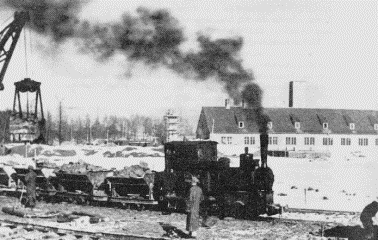 |
| Ill. 3: Photography of crematorium II in Birkenau, February 1943. |
 |
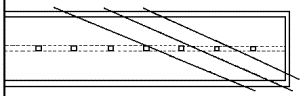 |
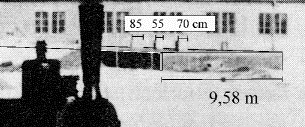
| Ill. 4: Enlargement of Ill. 13. The width of all three objects vary between 55 and 80 cm. Additionally the shades are different, indicating a different position and maybe a different shape/material. | Ill. 5: Cross section of morgue 1 of crematorium II. Perspective vanishing lines of objects, i.e., their possible locations, drawn in as crossing lines.[27e] |
There are also German documents that attest to the fact that the gas chamber was heated (a fact which, as I have pointed out above, strongly suggests that that room was not anymore to be used as a morgue. [misplaced parenthesis in original]If Prof. van Pelt would have read one of the most important sources for the study of Auschwitz and Birkenau thoroughly, he would have found out that the temporarily planned heating of one of the basement rooms of crematorium II was abandoned shortly afterwards.[28] This error of seeing only half of the story was already made by. Prof. Gerhard Jagschitz in his expert report in a court case in Vienna in 1991 and was criticized in the literature in 1994, where it was pointed out that according to contemporary expert literature morgues indeed did and do have a heating system to avoid frost in winter time.[29] Furthermore, there is no proof of heating installed in the alleged 'gas chambers' in crematorium I, II, and III, as well as the so-called Bunkers. Hence, all his pondering about what the installation of a heating system in a morgue might mean is futile effort.
It is important to note here that there is no indication that either Bischoff or Prüfer envisioned a homicidal use for the smaller morgue in the new crematorium. But the presence of the powerful ventilation system charged the design from its inception with a genocidal potentiality which would only require small modifications in the design to be actualized. Indeed: it was the presence of such a ventilation system in the crematorium of the main camp which, seven weeks earlier, had inspired Lagerführer Fritsch to use the mortuary of the crematorium as an experimental gas chamber.Prof. van Pelt doesn't give any reference for his experimental gassing claim. But what is more important: He hides the actual performances of the ventilation systems, which indeed reveal that morgue 1, the alleged 'gas chamber', was never intended to be used as a homicidal 'gas chamber'.
| morgue 1 ('gas chamber'): | 9.94 exchanges per h | morgue 2 ('undressing cellar'): | 10.35 exchanges per h |
that the doors to the gas chambers, located on the left of the plan but depicted on the right of the elevation, open again to the outside.Has he noted that these were double doors that could impossibly be made gas tight and could hardly be sufficiently reinforced against hundreds of panicking victims? That all doors in Auschwitz, even those made provisionally 'gas tight' (they were never gas tight in a technical sense) were made out of simple wood? That such doors, especially when opening outwardly, could never resist a panicking crowd of several hundred people?[32]
Furthermore he [Leuchter] wrongly inferred from the ruins of crematoria 2 to 5 that the walls of the gas chambers had not been coated, […]Though it is correct that we do not know anything about the walls of the crematoria IV and V, the walls of the alleged 'gas chambers' of the crematorium II is still today partly intact and can be investigated: The walls of this room had a plaster of cement mortar, but no paint or other coating. It must be assumed that crematorium III was built in a similar way. It is astonishing to see how Prof. van Pelt, who claims to have visited this place at least once, can spread such untruth. Or is he unaware of the fact that the expert term "coating", as referred to by Leuchter, means at least partly gas tight coating, and that plaster is without any doubt not a gas tight coating? In fact, Leuchter was talking about some water- and/or gas tight paint such as that applied to kitchen and bathroom walls today and as it can be seen on the walls of the delousing facilities in the Dachau concentration camp still today. Neither cement mortar nor lime mortar, the materials used in the crematoria and delousing facilities in Birkenau, can be called coatings.
First of all, the delousing chambers were designed to operate with very high concentrations of hydrogen cyanide—between 40 and 70 times the concentration the Germans used to kill humans in Birkenau—[…]To establish the amount of Zyklon B and thus the resulting concentration of hydrogen cyanide in the alleged 'gas chambers', we have several sources.
Then he [Leuchter] took no account of the fact that […] their [the crematoria's] remains had been exposed to the elements for 45 years, and that the walls had been washed with acid rain—a fact of some importance because, contrary to Leuchter's belief, ferro-ferri-cyanide is not stable under all conditions, but tends to slowly dissolve in an acidic environment.Prof. van Pelt's claim is totally unfounded and has been disproved: The relevant literature consistently describes Iron Blue as an extremely stable pigment. It is insoluble in water,[40] resistant to acid rain[41] and also surprisingly resistant to sunlight.[42] When exposed to weathering, other compounds of hydrocyanic acid will even convert preferentially into Iron Blue. Three examples will demonstrate the environmentally resistant nature of Iron Blue:
Roth explained that cyanide will react on the surface of brick or plaster, penetrating the material not more than 10 microns, or 0.01 mm, or one tenth the thickness of a human hair (one micron equals 1/1,000,000 of a meter, or 0.000039 inch). In other words, if one wants to analyze the cyanide concentration in a brick sample, one should take a representative sample of the surface, 10 microns thick, and no more.This statement is so stupid that, for a long time, I refused to pick it up in the first place. But since more and more inquiries are being sent to me, I feel obliged to publicly accuse Prof. Dr. James Roth of lying and/or being incompetent, and I hope that once he will be sorry for this nonsense. I justify my accusation as follows:
|
Cyanide concentrations in selected plaster samples taken from the walls of the Birkenau delousing chambers. Acc. to G. Rudolf/Institut Fresenius, Taunusstein, Hesse, Germany Values given in mg per kg; %Fe: Proportion of total iron content of sample converted to Iron Blue (Rudolf Gutachten,3 chapter 4. For more details about where the samples were taken, see there) |
||||||
|
No |
Building |
Location and depth of sample taken |
Material |
c[CN-] |
c[Fe] |
%Fe |
|
9 |
B1a BW 5a |
Inner side, external wall (West), 120 cm from Northern wall, 155 cm from floor, 0-2 mm. |
Plaster |
11000.0 |
12000 |
75 |
|
11 |
B1a BW 5a |
As 9, 1-10 mm. |
Plaster |
2640.0 |
6000 |
36 |
|
12 |
B1a BW 5a |
Easter wall (inside), 170 cm from Northern Wall, 170 cm from floor, (east. Hot air chamber), 0-2 mm. |
Plaster |
2900.0 |
8500 |
28 |
|
13 |
B1a BW 5a |
As 12, 2-10 mm. |
Plaster |
3000.0 |
9000 |
27 |
|
14 |
B1a BW 5a |
Outside Western wall, 40 cm from Southern side, 160 cm from soil, 0-5 mm. |
Brick |
1035.0 |
25000 |
3,5 |
|
15a |
B1a BW 5a |
Outside Southern wall, 40 cm from Western side, 210 cm from soil, 0-3 mm. |
Mortar |
1560.0 |
10000 |
13 |
|
16 |
B1b BW 5b |
Outside Southern wall, 2 m from entrance door, 1 m from soil, 0-7 mm. |
Brick |
10000.0 |
47000 |
17 |
|
17 |
B1b BW 5b |
Inside, Southern wall, 130 cm from Eastern wall, 130 cm from floor, 4-10 mm. |
Plaster |
13500.0 |
15000 |
74 |
|
19a |
B1b BW 5b |
Inside, Northern wall, 230 cm from Eastern wall, 90 cm from floor, 0-4 mm. |
Plaster |
1860.0 |
4300 |
35 |
|
19b |
B1b BW 5b |
As 19a, 4-8 mm. |
Plaster |
3880.0 |
9500 |
33 |
|
20 |
B1a BW 5a |
Inside, external wall (West), 40 cm from Sothern wall, 210 cm from floor, 0-3 mm. |
Lime Plaster |
7850.0 |
11000 |
59 |
|
22 |
B1a BW 5a |
Inner side of exterior wall (South), 40 cm from Western wall, 155 cm from floor, 3-10 mm. |
Lime Plaster |
4530.0 |
11000 |
34 |
In porous materials such as brick and mortar, the Prussian blue could go fairly deep as long as the surface stayed open, but as the Prussian blue formed, it was possible that it would seal the porous material and stop the penetration.So Prof. Roth is either a liar or a liar having committed perjury. Not a nice alternative, is it?
clearly show the presence of cyanide in the walls of the gas chambers, confirming the "alleged" use of these spaces as killing installations.As a matter of fact, small amounts of cyanide residues were found even by Leuchter and by me in some samples taken from walls of rooms allegedly used as homicidal 'gas chambers'. But this does by no means proof that these gassings took place. In fact, I have made much more thorough analyses to determine how small cyanide results can be interpreted. Some interesting results from various samples taken from buildings in Auschwitz (marked), Birkenau and elsewhere, analyzed for total cyanide, are given in the following table:
|
Low level cyanide results (in mg/kg) |
||||
| Author |
Sample no. |
Location |
History |
CN- |
| Fred Leuchter |
15 |
crematorium IV |
Material of unknown origin used by the Museum authorities after the war to rebuild parts of the walls |
2.3 |
| Fred Leuchter |
16 |
crematorium IV |
Material of unknown origin used by the Museum authorities after the war to rebuild parts of the walls |
1.4 |
| Fred Leuchter |
20 |
crematorium IV |
Material of unknown origin used by the Museum authorities after the war to rebuild parts of the walls |
1.4 |
| Fred Leuchter |
21 |
crematorium IV |
Material of unknown origin used by the Museum authorities after the war to rebuild parts of the walls |
4.4 |
| Fred Leuchter |
22 |
crematorium IV |
Material of unknown origin used by the Museum authorities after the war to rebuild parts of the walls |
1.7 |
| Fred Leuchter |
28 |
crematorium I (Auschwitz) |
Washing room, during the war not included in so-called 'gas chamber' |
1.3 |
| Germar Rudolf |
25 |
Bavarian Farm House |
Brick taken from a collapsed Bavarian farmhouse in Lower Bavaria in summer 1991 |
9.6 |
| Germar Rudolf |
25 |
Bavarian Farm House |
As above, but analyzed by Institute für Umweltanalytik Stuttgart (IUS) |
9.6 |
| Germar Rudolf |
8 |
Camp section B1b, inmates hut #13 |
2.7 |
|
| Germar Rudolf |
8 |
Camp section B1b, inmates hut #13 |
As above, but analyzed by Institute für Umweltanalytik Stuttgart (IUS) |
0.0 |
| Germar Rudolf |
10 |
Camp section B1a, delousing facility BW 5a |
Internal wall added while the building was reconstructed into a hot air delousing facility |
3.6 |
| Fred Leuchter |
1-7 |
crematorium II |
Results of various samples taken from the walls/ceiling of alleged 'gas chamber' (corpse cellar 1) |
0.0 |
| Fred Leuchter |
8 |
crematorium III |
Alleged 'gas chamber' (corpse cellar 1) |
1.9 |
| Fred Leuchter |
9 |
crematorium III |
Alleged 'gas chamber' (corpse cellar 1) |
6.7 |
| Germar Rudolf |
1 |
crematorium II |
7.2 |
|
| Germar Rudolf |
2 |
crematorium II |
0.6 |
|
| Germar Rudolf |
3 |
crematorium II |
6.7 |
|
| Germar Rudolf |
3 |
crematorium II |
As above, but analyzed by Institute für Umweltanalytik Stuttgart (IUS) |
0.0 |
| Germar Rudolf |
11 |
Camp section B1a, BW 5a (delousing) |
2640.0 |
|
| Germar Rudolf |
11 |
Camp section B1a, BW 5a (delousing) |
As above, but analyzed by Institute für Umweltanalytik Stuttgart (IUS) |
1430.0 |
|
Germar Rudolf: If not stated otherwise, analyzed by Institute Fresenius, Taunusstein |
||||
It is hard to imagine the chemical reactions and physicochemical processes that could have led to the formation of Prussian blue in that place
We decided therefore to determine the cyanide ions using a method that does not induce the breakdown of the composed ferrum cyanide complex (this is the blue under discussion) […]
|
Comparison of the order of magnitude of analyses results of different samples |
|||
|
Author: |
Markiewicz et al. |
Leuchter |
Rudolf |
|
Detection of: |
Cyanide without Iron Cyanides |
Total Cyanide |
Total Cyanide |
| Delousing Chambers |
0 - 0,8 mg/kg |
1.025 mg/kg |
1.000 - 13.000 mg/kg |
| Alleged 'Gas Chamber' |
0 - 0,6 mg/kg |
0 - 8 mg/kg |
0 - 7 mg/kg |
| Inmates Hut |
0 mg/kg |
- |
0 - 3 mg/kg |
| Gassed Samples |
0 - 12 mg/kg |
- |
50 - 100 mg/kg |
Leuchter wrongly assumed that Auschwitz gas chambers were not ventilated. Furthermore, he wrongly hypothesized that the gas chambers operated at very low temperatures, and that therefore there would have been "a considerable amount of condensation of liquid hydrogen cyanide on the walls, floor and ceiling of these facilities."[63] Furthermore he wrongly inferred from the ruins of crematoria 2 to 5 that the walls of the gas chambers had not been coated, and that therefore the liquid hydrogen cyanide could have reacted with the iron in the bricks and mortar to form ferro-ferri-cyanide. Then he wrongly reasoned that, in accordance with American practice, the Germans had used a high concentration of 3,600 parts of hydrogen cyanide per million parts of air—the concentration used in United States gas chambers to ensure that the condemned will die a quick death—while in fact the Germans used a concentration of 300 parts per million to kill their victims.[64] Neither did he consider the amount of hydrogen cyanide that would be absorbed by the bodies of the victims.As the only ruin where proper research can be done is the crematorium II, I shall restrict myself to this building, referring to what I already explained above:
 Since the air intake and outlet at the same wall of the morgue were very close together (2 m) - in contrary to those at the opposite wall (7,3m) - this would have led to a air short circuit, drastically reducing the performance of the ventilation. (Picture to the left: cross section through morgue 1 of crema II & III.)
 I don't know were the effective time of one air exchange equivalent would have been, but certainly not at the ideal value of 6 min, not even close to 12 min. Taking the value of 24 min might be too conservative - it probably took longer - but I want to be an the save side for the following table, which lists the times needed to reach some threshold values of HCN:
Germar Rudolf, Hastings, last revised: April 10, 2000
| [1] | I actually assumed my wife's last name in May 1994, but in order to protect my family from anti-revisionist hrrassment and persecution, I don't use it in public. |
| [2] | Frederick A. Leuchter, The first Leuchter Report, Samisdat Publishers, Toronto 1988 (www.zundelsite.org/english/leuchter/report1/leuchter.toc.html) |
| [3] | Rüdiger Kammerer, Armin Solms (ed.), Das Gutachten. Gutachten über die Bildung und Nachweisbarkeit von Cyanidverbindungen in den 'Gaskammern' von Auschwitz, Cromwell Press, London 1993 (www.vho.org/D/rga/rga.html). |
| [4] | I intentionally put 'gas chambers' in quotation marks for the following reason: In the contemporary German expert literature as well as in many blueprints of German architectural maps, this term was exclusively used to describe delousing facilities, but never in the context of 'homicidal gas chambers'. Nevertheless I do understand that whenever this term is used today, a 'homicidal gas chamber' is normally meant. But since this is a corruption of the original term, I put it in quotation marks to distinguish it from the original term referring to delousing gas chambers. |
| [5] | Landgericht Stuttgart, ref. 17 KLs 18/94. The court did wrongly assume that I had agreed with these comments prior to the distribution of this commented version. For a translation of the comments that I was punished for, see www.vho.org/GB/Books/cq/remer.html |
| [6] | The first edited under the pen name Ernst Gauss: Grundlagen zur Zeitgeschichte. Ein Handbuch über strittige Fragen des 20. Jahrhunderts, Grabert, Tübingen 1994. (vho.org/D/gzz/index.html; English version www.vho.org/GB/Books/dth/index.html); the second edited under the name Herbert Verbeke: Auschwitz: Nackte Fakten. Eine Erwiderung an Jean-Claude Pressac, Vrij Historisch Onderzoek, Berchem 1995 (www.vho.org/D/anf/AR.html; English in preparation). |
| [7] | Grundlagen zur Zeitgeschichte, op. cit. |
| [8] | Amtsgericht Tübingen, ref. Az. 4 Gs 173/95; Prof. Dr. Ernst Nolte (Berlin), Dr. Joachim Hoffmann (Freiburg); see "Deutsches Gerichtsurteil: Wissenschaftliches Werk wird verbrannt!", in: Herbert Verbeke (ed.), Kardinalfragen zur Zeitgeschichte, Vrij Historisch Onderzoek, Berchem 1996; English www.vho.org/GB/Books/cq/burn.html; for a complete reprint of the expert report of Dr. Hoffmann see "Grundlagen zur Zeitgeschichte: Gutachterliche Stellungnahme", Vierteljahreshefte für freie Geschichtsforschung 1(3)(1997), pp. 205ff. (vho.org/VffG/1997/3/Hoffmann3.html); English: www.vho.org/GB/Books/dth/fndHoffmann.html |
| [9] | Unfortunately, this is common practice in Germany, see my documentation about censorship in Germany (written under the pen name Anton Maegerle) at www.vho.org/censor/D.html#GB. |
| [10] | Vierteljahreshefte für freie Geschichtsforschung, www.vho.org/VffG/index.html. |
| [11] | A paper by an architect is currently been prepared for publication in Vierteljahreshefte für freie Geschichtsforschung about these details. Even the stoves built in these rooms indicate such a purpose: they had to be fired from outside. |
| [12] | Concentration is here referred to as mass of hydrogen cyanide per volume. That makes our calculation independent from the actual volume of the room discussed. |
| [13] | J.-C. Pressac, Auschwitz: Technique and Operation of the Gaschambers, Beate Klarsfeld Foundation, New York 1989, pp. 483f. |
| [14] | See for that Carlo Mattogno, " Auschwitz: A case of plagiarism ." JHR, Spring, 1990; vol. 10 no. 1: p. 5 (ihr.org/jhr/v10/v10p--5_Mattogno.html). |
| [15] | Pressac, op. cit., note 13, p. 489. |
| [16] | Carlo Mattogno, Franco Deana, "Die Krematoriumsöfen von Auschwitz-Birkenau", in: Ernst Gauss (ed.), Grundlagen zur Zeitgeschichte, Grabert, Tübingen 1994 (vho.org/D/gzz/13.html; Engl.: www.vho.org/GB/Books/dth/fndcrema.html). |
| [17] | J. H. Perry, Chemical Engineer’s Handbook, Wilmington, Delaware, 1949, p. 1584, quoted acc. to C. Mattogno, op.cit., note 16. |
| [17a} | Filip Müller, Sonderbehandlung, Steinhausen, Munich . 95; cf. the critique of Jürgen Graf, Auschwitz: Tätergeständnisse und Augenzeugen des Holocaust, Neue Visionen, Würenlos, 1994, p. 139-154. |
| [18] | Protocol testimony Michael Kula, 11 June 1945, added as Appendix 16 to: Cracow District Commission for the Investigation of German War Crimes, “Protocol on the Machinery of Mass Extermination of Humans in Birkenau”, 26 November 1946, transl. Roman Sas-Zalaziocky, in Republic of Austria, Ministry of Justice, Case 20 Vr 3806/64 (Ertl/Dejaco), Landesgericht für Strafsachen, Vienna, file ON 393v (r & v). |
| [18a] | Carlo Mattogno, "The First Gassing at Auschwitz: Genesis of a Myth", The Journal of Historical Review, 9(2) (1989), pp. 193-222 (online: www.vho.org/GB/Journals/JHR/9/2/Mattogno193-222.html) |
| [18b] | Cf. expert literature about toxicology, e.g. W. Wirth, C. Gloxhuber, Toxikologie, Georg Thieme Verlag, Stuttgart 1985, p. 159f.; W. Forth, D. Henschler, W. Rummel, Allgemeine und spezielle Pharmakologie und Toxikologie, Wissenschaftsverlag, Mannheim 1987, p. 751f.; S. Moeschlin, Klinik und Therapie der Vergiftung, Georg Thieme Verlag, Stuttgart 1986, p. 300; H.-H. Wellhöner, Allgemeine und systematische Pharmakologie und Toxikologie, Springer Verlag, Berlin 1988, p. 445f. |
| [18c] | Zündel Trial in Toronto in 1985, transcription, pp.1447-1448, 1636. The book in question is: R. Vrba, I Cannot Forgive, Bantam Books, Toronto 1964; cf. Robert Faurisson, "Witnesses to the Gas Chambers of Auschwitz", online: www.vho.org/GB/Books/dth/fndwitness.html |
| [19] | I had to retranslate that from German (acc. to Jürgen Graf, Auschwitz: Tätergeständnisse und Augenzeugen des Holocaust, Neue Visionen GmbH, Verlag, CH-8116 Würenlos (Schweiz), August 1994). If someone has the original English wording, please forward it so that I can substitute it; I cannot forgive, Bantam, Toronto, 1964, p. 10 ff. |
| [20] | This too was retranslated from Graf's book, sorry: "The Extermination Camps of Auschwitz (Oswiecim) and Birkenau in Upper Silesia", Franklin Delano Roosevelt Library, New York, Collection War Refugee Board, Box no 6, German Extermination camps, 1. Original Reports from McClelland, 10-12-44 |
| [21] | This too was retranslated from Graf's book, sorry: Olga Lengyel, Five Chimneys, Chicago/New York, 1947, pp. 72 ff. |
| [22] | Hefte von Auschwitz, Sonderheft 1, Handschriften von Mitgliedern des Sonderkommandos, Verlag Staatliches Auschwitz-Museum, 1972, S. 42 ff. |
| [23] | Document 159, "Experiences of a Fifteen-Year-Old in Birkenau," in David A. Hackett (ed.), The Buchenwald Report, Westview Press, San Francisco and Oxford 1995, p. 349. |
| [24] | Ota Kraus and Erich Schön-Kulka, Továrna na Smrt, Cin, Prague1946, p. 121f. |
| [25] | See Knud Bäcker, "Das Krematorium von Auschwitz-Birkenau in der Kriegspropaganda und in der sowjetischen Nachkriegsdarstellung", Vierteljahreshefte für freie Geschichtsforschung 3(1) (1999), pp. 39-63 |
| [25a] | "Engineers of Death", The New York Times, July 18, 1993, p. E19; cf. Der Spiegel, 40/1993, p. 162 |
| [26] | R.J. van Pelt, Deborah Dwork, Auschwitz: 1270 to the Present, Yale University Press, New Haven and London 1996, p. 270. |
| [26a] | Dino A. Brugioni, Robert G. Poirier, "The Holocaust Revisited: A Retrospektive Analysis of the Auschwitz-Birkenau Extermination Complex", CIA, Washington 1979, p. 15. Thanks to Fritz P. Berg for this argument. |
| [27] | Ref. No. RG 373 Can B 8413, exp. 6V2, J. C. Ball, Air Photo Evidence, Ball Resource Services Ltd., Suite 160-7231, 120th St., Delta, BC, Canada, V4C 6P5, 1992, p. 65. Cf. http://www.air-photo.com/ |
| [27a] | J.-C. Pressac, op. cit. (note 13), p. 340, dated roughly Feb. 9-11, 1943. |
| [27b] | D. Czech, Kalendarium der Ereignisse im Konzentrationslager Auschwitz-Birkenau 1939 - 1945, Rowohlt, Reinbek 1989, p. 454. |
| [27c] | D. Czech, op. cit. (note 27b), p. 398, and J.-C. Pressac, op. cit. (note 13), p. 335. |
| [27d] | J.-C. Pressac, op. cit. (note 13), p. 341, even if Pressac states here that they are visible. He must have been drunken when writing this, as he frequently was as he admitted, ibid., p. 537. |
| [27e] | Taken from Jean-Marie Boisdefeu, La controvers sur L'extermination des Juifs par les Allemands, vol. 1, V.H.O., Berchem 1994, p. 168. |
| [28] | J.-C. Pressac, op.cit., note 13, p. 221, 223. This heating was temporarily discussed because the forced-draught fans of the crematorium needed cooling, but they failed soon (they burned out), and thus the project was dropped. |
| [29] | W. Rademacher, in: Ernst Gauss, Grundlagen zur Zeitgeschichte, Grabert, Tübingen 1994 www.vho.org/GB/Books/dth/fndluftl.html |
| [30] | Re. requirements see W. Heepke, Die Leichenverbrennungs-Anstalten (die Krematorien), Verlag von Carl Marhold, Halle a.S. 1905, p. 104; re. performance in Auschwitz: Archive of Auschwitz Museum, D-Z/Bau, nr. inw. 1967, pp. 246 - 247; cf. C. Mattogno's research on this in "Auschwitz: Das Ende einer Legende", in: H. Verbeke (ed.), Auschwitz: Nackte Fakten, VHO, Berchem 1995 http://www.vho.org/D/anf/MattognoR.html; English; Auschwitz: The End of a Legend, Granata, Palos Verdes 1994. |
| [31] | P. Puntigam, H. Breymesser, E. Bernfus, Blausäurekammern zur Fleckfieberabwehr, Sonderveröffentlichung des Reichsarbeitsblattes, Berlin 1943, p. 50. The documents quoted here and in note 30 can be found at C. Mattogno's quoted article (note 30); http://www.vho.org/D/anf/MattognoR.html |
| [32] | See the analysis of those 'gas tight' doors by Hans Jürgen Nowak and Werner Rademacher, "'Gasdichte' Türen in Auschwitz", Vierteljahreshefte für freie Geschichtsforschung 2(4) (1998), pp. 248-261 (www.vho.org/VffG/1998/4/NowRad4.html. English as part of M. Gärtner et al., "Some Details of the Building Administration of Auschwitz", in: E. Gauss (ed.) Final Solution for the Holocaust, www.vho.org/GB/Books/dth/fndNowak.html |
| [32a] | See Manfred Gerner, "'Schlüsseldokument' ist Fälschung", Vierteljahreshefte für freie Geschichtsforschung 2(4) (1998), pp. 166-174 (www.vho.org/VffG/1998/3/Gerner3.html. English as part of M. Gärtner et al., "Some Details of the Building Administration of Auschwitz", in: E. Gauss (ed.) Final Solution for the Holocaust, www.vho.org/GB/Books/dth/fndNowak.html; Carlo Mattogno, "The Auschwitz Central Construction Headquarters Letter Dated 28 June 1943: An Alternative Interpretation" |
| [32b] | Protocol of the case, op. cit. (note 13 ), January 25, 2000, p. 18, defense lawyer Rampton: "Professor van Pelt has not read the Rudolf report.", p. 23, Prof. van Pelt: "I am vaguely familiar with it. I have not read it in its entirety", referring to the 16 pages English language short version of my report, which is absolutely not sufficient to get an idea about the 120 pages full version (Rüdiger Kammerer, Armin Solms (eds.), A Scientific Sensation: The Rudolf Report. A Discussion of the Rudolf Report on the Formation and Demonstrability of Cyanide Compounds in the Gas Chambers at Auschwitz, with additional research findings on the Holocaust, Cromwell Press, London 1994.). The order address for the full version is given in that summary, but van Pelt obviously did not feel the need to get hold of it. |
| [33] | "How to get rid of termites", Life, 22.12.1947, p. 31. |
| [34] | Cf. J. Buszko (ed.), Auschwitz, Nazi Extermination Camp, 2nd edition, Interpress Publishers, Warschau 1985, p. 118; mass given in Zyklon B, which means 6-12 kg of hydrogen cyanide, as the mass given on the Zyklon B cans always refer to the actual content of hydrogen cyanide. |
| [35] | The only exception to this is the alleged first trial gassing in a basement room of one of the inmate barracks in Auschwitz-Stammlager. For a critique of that see: Carlo Mattogno, "The first gassing at Auschwitz: Genesis of a myth", The Journal of Historical Review, Summer, 1989; vol. 09 no. 2: p. 193-222; for 'eyewitness accounts' on the duration of gassings otherwise see: Schwurgericht Hagen, Urteil vom 24.7.1970, ref. 11 Ks 1/70, S. 97 (5 min.); examination of eye witness R. Böck, Schwurgericht Frankfurt, ref. 50/4 Ks 2/63, ref. 4 Js 444/59, p. 6881 f. (8-10 min.); Final Trial Brief of the Prosecution, in: U. Walendy, Auschwitz im IG-Farben-Prozeß, Verlag für Volkstum und Zeitgeschichtsforschung, Vlotho 1981, pp. 47-50 (3-15 min); E. Kogon, H. Langbein, A. Rückerl et al., Nationalsozialistische Massentötungen durch Giftgas, S. Fischer Verlag, Frankfurt 1983, passim (immediately to 10 min., rarely up to 20 min.); J. Buszko (ed.), op.cit., pp. 114 + 118 (a few min.); H.G. Adler, H. Langbein, E. Lingens-Reiner (ed.), Auschwitz, 3rd ed., Europäische Verlagsanstalt, Köln 1984, pp. 66, 80 + 200 (a few to 10 min.); Hamburger Institut für Sozialforschung (ed.), Die Auschwitz-Hefte, vol. 1, Beltz Verlag, Weinheim 1987, pp. 261ff. +294 (immediately to 10 min.); C. Vaillant-Couturier, Der Prozeß gegen die Hauptkriegsverbrecher vor dem Internationalen Miltärgerichtshof Nürnberg (IMT), vol. VI, p. 242, vol. XVI, p. 499f. (5-7 min.); M. Nyiszli Im Jenseits der Menschlichkeit, Dietz Verlag Berlin, 1992, p. 32ff. ("five min."); C.S. Bendel in: H. Langbein, Menschen in Auschwitz, Europaverlag, Wien 1987, p. 221 (end of crying victims after 2 min.); P. Broad in: B. Naumann, Auschwitz, Athenäum, Frankfurt/Main 1968, p. 217 (4 min.), after 10-15 min opening of doors: A. Rückerl, NS-Verbrechen vor Gericht, 2nd ed., C.F. Müller, Heidelberg, 1984, p. 58f.; K. Hölbinger in: H. Langbein, Der Auschwitz-Prozeß, Europäische Verlagsanstalt, Frankfurt/Main 1965, p. 73 (1 min.): R. Böck, ibid., p. 74 (after doors are closed 10 min. crying victims, afterwards opening of doors); H. Stark, ibid., p. 439 (10-15 min. crying victims); F. Müller, ibid., p. 463 (8-10 min.); E. Pyš, ibid., p. 748 (after a few min. ventilation was switched on); K. Lill, ibid., p. 750 (e few seconds after pouring in Zyklon B an outcry, a few minutes later smoke came out of the chimney); protocol of the expert report of Prof. Dr. G. Jagschitz, 3.-5. day of trial against Gerd Honsik, April 29., April 30., Mai 4., 1992, ref. 20e Vr 14184 and Hv 5720/90, Landgericht Wien, p. 443 (2-3 min); Dokument 3868-PS, IMT-vol. 33, p. 275ff., quoted acc. To L. Rosenthal, "Endlösung der Judenfrage", Massenmord oder "Gaskammerlüge"?, Verlag Darmstädter Blätter, Darmstadt 1979 (2 to in rare occasions up to 15 min); R. Höß, in: M. Broszat (ed.), Kommandant in Auschwitz, Deutsche Verlags-Anstalt, Stuttgart 1958 (30 min for entire procedure, including ventilation); Hans Münch, in G. Rudolf, "Auschwitz-Kronzeuge Dr. Hans Münch im Gespräch", Virteljahreshefte für freie Geschichtsforschung, 1(3) (1997), pp. 139-190 (2 (summer) -5 min (winter)); Salmen Lewenthal, Hefte von Auschwitz, Sonderheft 1, Handschriften von Mitgliedern des Sonderkommandos, Verlag Staatliches Museum Auschwitz, 1972, S. 155 ("sudden silence"); Dov Paisikovic, in: Léon Poliakov, Auschwitz, René Julliard, 1964, S. 159 ff. ("3-4 min."), Franke-Grcksch Report, in: J.-C. Pressac, op.cit. (note 15), p. 238 (one minute to kill, another until doors are opened); Rudolf Vrba alias Walter Rosenberg, Alfred Wetzler, archival no. M 20/153, Yad Vashem (quoted in: War Refugee Board, "German Extermination Camps - Auschwitz and Birkenau", in David S. Wyman (ed.), America and the Holocaust, vol. 12, Garland, New York/ London 1990, p. 20: "At the end of three minutes everyone in the room has died."); Jerzy Tabeau, in: The Extermination Camps of Auschwitz (Oswiecim) and Birkenau in Upper Silesia.??? (10 min.); André Lettich, Trente-quatre mois dans les Camps de Concentration, Imprimerie Union Coopérative, Tours, 1946 ("several moments"). Janda Weiss tells us acc. to van Pelt: "The lungs of the victims slowly burst, and after three minutes a loud clamoring could be heard. Then the chamber was opened, and those who still showed signs of life were beaten to death" (Document 159, "Experiences of a Fifteen-Year-Old in Birkenau," in Hackett, ed.. The Buchenwald Report, 349). Longer periods of time to kill usually refer to the crematoria IV/V, the Bunkers 1/2 or crema I in the Stammlager. The killings in crema II&III supposedly took place extremely quickly. |
| [36] | See for example: The News & Observer, Raleigh (NC), 11 June 1994, p. 14A; ibid., 19 June 1994, p. A1; Newsweek, 8 November 1993, p. 75; The New York Times, 6 October 1994, p. A20; ibid., 16 June 1994, p. A23; Bettina Freitag, "Henker warten nicht", New Yorker Staats-Zeitung, 13 March - 19. March 1999, p. 3; (according to the prison’s warden normally 10 - 14 min.); C.T. Duffy, 88 Men and 2 Women, Doubleday, New York 1962, p. 101 (13-15 min.); C.T. Duffy has been the director of the prison of San Quentin for almost 12 years, and in this time he ordered the execution of 88 men and 2 women, many of them being executed in the local 'gas chamber'; Stephen Trombley, The Execution Protocol, Crown Publishers, New York 1992, p. 13 (around or more than 10 min.); Amnesty International, Botched Executions, Fact Sheet December 1996, distributed by Amnesty International USA, 322 Eighth Avenue, New York, NY 10001-4808 (more than 7 min). See also Conrad Grieb (alias Friedrich OPaul Berg), " Der selbstassistierte Holocaust-Schwindel", Vierteljahreshefte für freie Geschichtsforschung 1(1) (1997), S. 6ff., www.vho.org/VffG/1997/1/Grieb1.html; English: www.codoh.com/gcgv/gcgvself.html |
| [37] | Cf. The News & Observer, Raleigh (NC), 11 June 1994, p. 14A. |
| [38] | Cf. R. Irmscher, "Nochmals: 'Die Einsatzfähigkeit der Blausäure bei tiefen Temperaturen'", Zeitschrift für hygienische Zoologie und Schädlingsbekämpfung, 1942, p. 35f.; we assume an average temperature of the Zyklon B carrier material (gypsum) of not more than 20°C (most likely the carrier would have been colder due to cold floors and energy loss during evaporation) and a rel. humidity of roughly 100% (cold, damp basement filled with humans); for more details see Wolfgang Lambrecht, "Zyklon B – eine Ergänzung", Vierteljahreshefte für freie Geschichtsforschung 1(1) (1997), pp. 2-5 www.vho.org/VffG/1997/1/Lambrecht1.html. |
| [39] | Order of magnitude means: roughly in the range of factor 3 to 30 (100,5 to 101,5). I don't give more exact data because our knowledge about the actual environmental conditions are not accurate enough. |
| [40] | The literature frequently gives only the rather unsatisfactory term ›insoluble‹. For more details see the Rudolf Gutachten, op. cit., note 3, pp. 45ff. |
| [41] | Iron blue is considered an acid-resistant pigment; cf. e.g. B. J. A. Sistino, in: T. C. Patton(ed.), Pigment Handbook, v. 1, Wiley, New York 1973, pp. 401-407; no appreciable decomposition occurs until the pH drops below 1. The pH of Iron Blue suspensions, for ex., is around 4-5; H. Ferch, H. Schäfer, Schriftenreihe Pigmente, 77, Degussa AG, Frankfurt 1990. |
| [42] | Ullmanns Encyklopädie der technischen Chemie, v. 13, Urban & Schwarzenberg, Munich 1962, p. 794; ibid., v. 18, Verlag Chemie, Weinheim 1979, pp. 623ff.; L. Müller-Focken, Farbe und Lack 84 (1987), pp. 489-492. |
| [43] | Illustration of this can be found in Rudolf Gutachten, op.cit., note 3. Similar are the cases of the delousing facilities in the Majdanek and Stutthof concentration camps, see Jürgen Graf, Carlo Mattogno, KL Majdanek. Eine historische und technische Studie, Castle Hill Publishers, Hastings 1998 (www.vho.org/D/Majdanek/MR.html); Jürgen Graf, Carlo Mattogno, Das Konzentrationslager Stutthof und seine Funktion in der nationalsozialistischen Judenpolitik, (with Jürgen Graf), Castle Hill Publishers, Hastings 1999 (www.vho.org/D/Stutthof/index.html). |
| [44] | J. M. Kape, E. C. Mills, Transactions of the Institute of Metal Finishing 35 (1958), pp. 353-384; ibid., 59 (1981), pp. 35-39. |
| [45] | D. Maier, K. Czurda, G. Gudehus, Das Gas- und Wasserfach, Gas × Erdgas 130 (1989), pp. 474-484. |
| [46] | For a detailed discussion of this and more see the acc. sections in my report (Chapter 2.4.ff & chapter 2.5.6.). |
| [47] | cf. W. Schlesiger, Der Fall Rudolf, Cromwell, 20 Madeira Place, Brighton/Sussex BN2 1TN, England, 1994, pp. 21-24 (www.vho.org/D/dfr/Fall.html); G. Rudolf, DGG 42(2) (1994), pp. 25f. (www.vho.org/D/DGG/Rudolf42_2.html; English: www.vho.org/GB/Books/cq/media.html). |
| [48] | Cf. W. Baker, A.L. Mossman, Matheson Gas Data Book, Matheson Gas Products, East Rutherford 1971, p. 301; See my report about the physical data of HCN, note 3, chapter 2.5. (www.vho.org/D/rga/hcn.html#eigen). |
| [49] | See the diffusion experiments with Zyklon B conducted by L. Schwarz, W. Deckert, Z. Hygiene und Infektionskrankheiten, 107 (1927), pp. 798-813; ibid., 109 (1929), pp. 201-212. |
| [50] | See my report about an analysis of the porosity of cement and lime mortar, note 3, chapter 2.5. (www.vho.org/D/rga/zement.html). |
| [51] | Cf. the pictures in my report, op. cit. (note 3) chapter 4.3.3.3., (vho.org/D/rga/prob9_22.html) and the book by Jürgen Graf and Carlo Mattogno, Konzentrationslager Stutthof, Castle Hill Publishers, Hastings pictures 1,4f., 14f., 17 im Abbildungsteil (online: vho.org/D/Stutthof/Dokumente.html). |
| [52] | J.-C. Pressac, note 15, p. 390; J. Markiewicz, W. Gubala, J. Labedz, B. Trzcinska, Gutachten, Prof. Dr. Jan Sehn Institut für Gerichtsgutachten, Abteilung für Gerichtstoxikologie, Krakau, 24. September 1990; partly published in: Deutschland in Geschichte und Gegenwart, 39(2) (1991), p. 18f. (www.vho.org/D/DGG/IDN39_2.html) |
| [53] | For Leuchter see: www.vho.org/D/rga/leucht.html (or the hardcopy referred to there); for Rudolf see: www.vho.org/D/rga/rudolf.html and www.vho.org/D/rga/prob1_8.html (or the hardcopy referred to there). |
| [54] | Jan Markiewicz, Wojciech Gubala, Jerzy Labedz, "A Study of the Cyanide Compounds Content in the Walls of the Gas Chambers in the Former Auschwitz and Birkenau Concentration Camps," Z Zagadnien Nauk Sadowych / Problems of Forensic Science, vol. XXX (1994) pp. 17-27 (online: www2.ca.nizkor.org/ftp.cgi/orgs/polish/institute-for-forensic-research/post-leuchter.report). |
| [55] | G. Rudolf, "Leuchter-Gegengutachten: Ein Wissenschaftlicher Betrug?", in: Deutschland in Geschichte und Gegenwart 43(1) (1995) pp. 22-26 (www.vho.org/D/Kardinal/Leuchter.html; Engl.: www.vho.org/GB/Books/cq/leuchter.html); G. Rudolf and J. Markiewicz, W. Gubala, J. Labedz, "Briefwechsel", in: Sleipnir, 1(3) (1995) pp. 29-33; reprinted in Herbert Verbeke (ed.), Kardinalfragen zur Zeitgeschichte, Vrij Historisch Onderzoek, Berchem 1996, pp. 86-90 (online: as above). |
| [56] | They actually quoted my book where all these points are explained and founded in detail, cf. Ernst Gauss, Vorlesungen über Zeitgeschichte, Grabert, Tübingen 1993, pp. 163ff., 290-294 (www.vho.org/D/vuez/v3.html#v3_4 and ~/v5.html#v5_5). |
| [57] | A construction damage case occurred in 1976 in Bavaria (Meeder-Weisenfeld), when a recently plastered church was gassed with Zyklon B. After several months the plaster was covered with blue patches formed by Iron Blue, see Günter Zimmermann (ed.), Bauschäden Sammlung, vol. 4, Forum-Verlag, Stuttgart 1981, pp. 120f.; reprint in Ernst Gauss (ed.), Grundlagen zur Zeitgeschichte, Grabert, Tübingen 1994, pp. 401ff.; (vho.org/D/gzz/17.html; English: www.vho.org/GB/Books/dth/fndwood.html.) Furthermore, all delousing facilities of former concentration camps in eastern Europe still existing today have developed enormous amounts of Iron Blue throughout the wall, cf. note 43. |
| [58] | G. Rudolf and J. Markiewicz, W. Gubala, J. Labedz, "Briefwechsel", op.cit. note 55. |
| [59] | J. Markiewicz, W. Gubala, J. Labedz, B. Trzcinska, "Gutachten", Prof. Dr. Jan Sehn Institute For Forensic Research, dep. for forensic toxicology, Kracow, September 24, 1990; partly published in: Deutschland in Geschichte und Gegenwart, 1991, 39(2), p. 18f. (www.vho.org/D/DGG/IDN39_2.html); English: "An official Polish report on the Auschwitz 'gas chambers'." Journal of Historical Review, Summer, 1991; vol. 11 no. 2: p. 207. This wrong claim is being repeated by Prof. van Pelt: "ferro-ferri-cyanide is not stable under all conditions, but tends to slowly dissolve in an acidic environment". |
| [60] | Prof. Dr. Jan Sehn Institute For Forensic Research, dep. for forensic toxicology, Kracow, letter to W. Wegner, undated (Winter 1991/92), signature illegible, but probably Dr. Markiewicz himself, unpublished. |
| [61] | See http://www.vho.org/D/rga/lueft.html for more mathematics. |
| [62] | See K. Wesche, Baustoffe für tragende Bauteile, Band 1, Bauverlag, Wiesbaden 1977, p. 37; L. Schwarz, W. Deckert, Z. Hygiene und Infektionskrankheiten, 107 (1927), p. 798-813; ibidem, 109 (1929), p. 201-212. |
| [63] | See the discussion in my report at http://www.vho.org/D/rga/zement.html |
| [64] | See on www.vho.org/GB/c/GR/CharacterAssassins.html for the recent state of the art. |